Propane vs Charcoal vs Open Fire: Which Outdoor Cooking Method Feels Right for the Moment?
Cooking outdoors is not always about food.
A lot of times, it is about the feeling around the food.
That is why this question matters more than it sounds. When you are deciding between propane, charcoal, or open fire, you are not just picking up a heat source. You are deciding what kind of pace the meal is going to have. You are deciding how involved you want to be. You are deciding whether dinner feels quick and simple, slow and steady, or something you are going to settle into for a while.
And that matters.
Because once cooking outside becomes something you genuinely enjoy, you stop thinking about it only as a way to get food done. It becomes part of the day itself. Part of the reason you wanted to be there in the first place.
That is where a lot of people miss the point.
They ask which method is best as if there is one right answer. But there really is not. The better question is which one fits the kind of outdoor time you want to have.
Sometimes, propane is exactly enough.
Sometimes charcoal is worth every extra minute.
Sometimes an open fire is the whole reason you wanted to cook outside at all.
And sometimes, honestly, you go inside because the weather turned; the wind picked up, or the day just did not unfold the way you thought it would.
That is real, too.
But when you do have the choice, the cooking method shapes more than just the food. It shapes the whole mood of the meal.
Propane is usually the simplest place to start.
You turn it on, light it, and you are cooking.
There is something to say about that.
Not every outdoor meal needs a ceremony. Not every evening needs to revolve around tending coals or building a fire. Sometimes you just want to be outside with a pan or a grill, hear a little breeze moving through the trees, and get dinner going without turning it into an event. Propane works well for that kind of day.
It gives you the benefit of being outdoors without making the process complicated.
And there is real value in that.
A propane grill or burner is dependable. The heat is predictable. You can make breakfast, sear a steak, cook sausage, grill vegetables, or get a quick dinner going without much thought. It feels clean. Controlled. Easy to work with. If you are tired, if time is short, or if you simply want a meal without a lot of build-up, propane makes a lot of sense.
That does not make it less.
It just makes it different.
Because propane still gets you outside. It still changes the meal a little. It still creates a distance between this meal and the one you would have made under kitchen lights. And some days, that little bit of distance is all you were really after anyway.
But propane usually is not the method people romanticize.
It is a practical one.
The useful one.
The one that earns its place because it works.
Charcoal, though, changes the rhythm right away.
Charcoal is slower from the start. You light it, and then you wait. The meal begins before the food ever touches the grate. There is no instant heat. No immediate payoff. You have to let it build. You must give it a little time. And that alone changes the mood.
You are not just cooking dinner anymore.
You are settling into dinner.
That is part of the charcoal’s appeal.

It asks something from you, but it gives you something back, too. The wait becomes part of the experience. You check the coal. You stand nearby. You watch the fire catch and the color change. The whole meal takes on a little more shape. A little more anticipation. You are involved earlier, and somehow that makes the food feel like it matters more once it gets there.
Have you ever noticed that when charcoal is going, the cooking starts to feel like the center of the evening instead of just another task you need to finish before dark?
That is where charcoal starts to separate itself.
It creates an atmosphere before it even cooks anything.
And then there is a flavor.
That part is real.
Charcoal gives food more character. Steak, burgers, chicken, vegetables, and even something simple like bread or onion, pick up a little more depth. Not in a fancy way. In a more grounded way. Food cooked over charcoal tastes as if it came from an actual fire, even if that fire is contained inside a grill. It carries a little smoke, a little edge, a little something that propane usually does not give you.
That is why so many people keep coming back to it.
Not because it is the easiest option.
Because it feels worth the trouble.
For someone who enjoys the process and not just the result, charcoal often hits a sweet spot. It gives you ritual without making things too unpredictable. It slows you down, but not too much. It gives the meal a little gravity.
And then there is an open fire.
Open fire is different from everything else.
It is not just another cooking option. It is an entirely different kind of experience. When you cook over an open fire, you are working with something alive. It shifts. It flares. It burns down. It moves with the wood, the air, the temperature, and the moment. There is no knob to turn and no easy way to make it perfectly even. You have to pay attention.
That is exactly why some people love it.
Open fire forces presence.
You cannot fully drift through it. You notice the heat. You move the pan. You wait for the flame to settle. You look for the hotter side. You work with the fire instead of controlling it. That makes cooking feel less polished and more real.
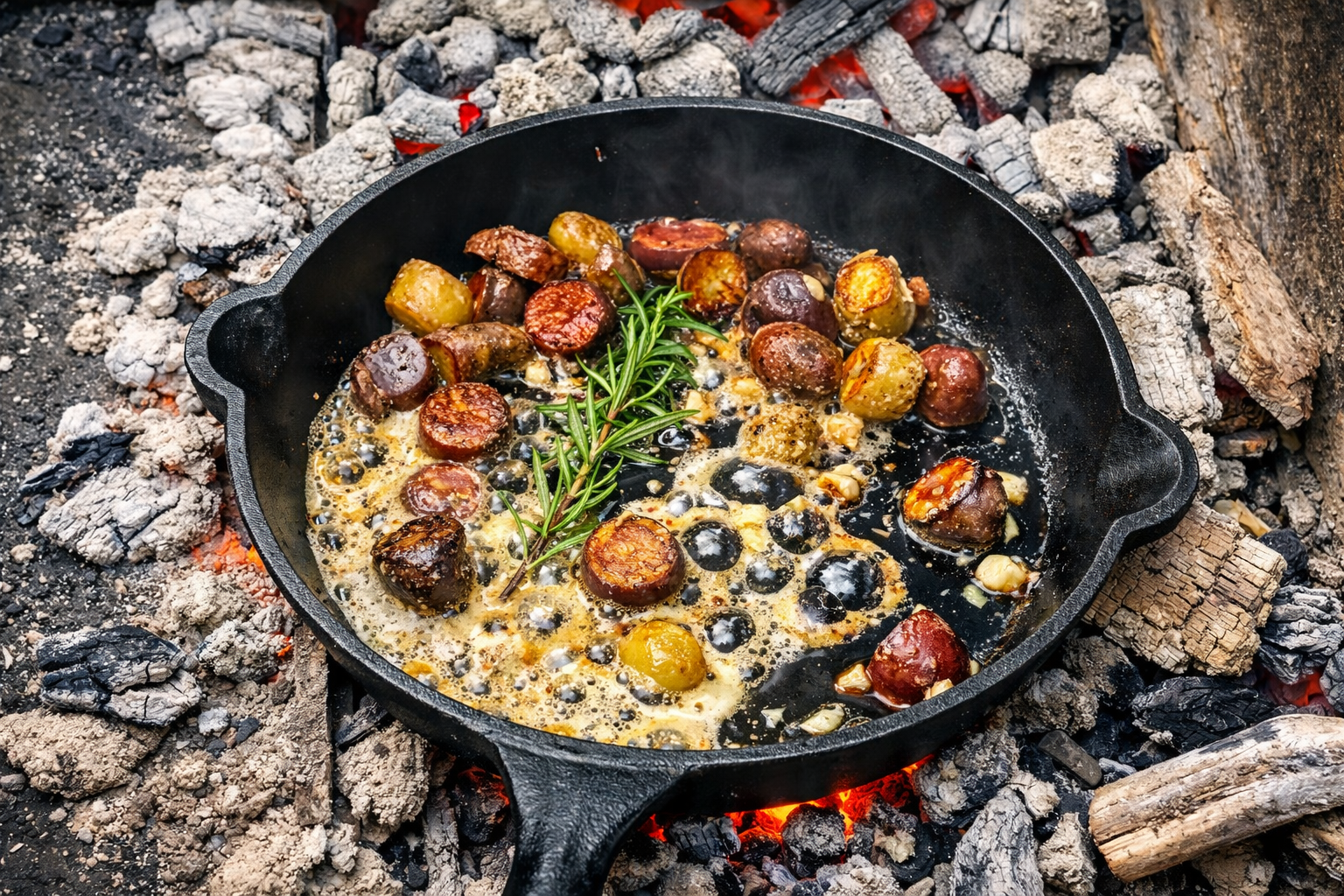
A cast-iron skillet over an open flame feels solid in a way that is hard to explain until you have done it enough times. The sound is different. The smell is different. The pan seems more at home there. A steak, potatoes, onions, beans, even something simple sizzling in a cast-iron over fire feels heavier in the best way. More connected to the place around you.
That is what open fire gives back.
Not convenient.
Not precision.
Something deeper than that.

It gives you an atmosphere. It gives you a sound. It gives you smoke in the air and a reason to stay close. It makes the cooking part of the setting rather than something happening beside it. And for the right kind of person, that is the whole draw.
Because not everybody wants outdoor cooking to feel efficient.
Some people want it to feel slower than the rest of their lives.
They want a little friction.
A little waiting.
A little reminder that the best parts of the meal do not always happen after it is plated.
Sometimes they happen while the wood is burning down and the pan is heating up.
That is where open fire stands apart.
It asks the most, but it often gives the most back, too.
That does not mean it is always the right choice. It is not. Some days it is too windy. Some evenings it is too much work. Sometimes you are hungry, tired, or just not in the mood to manage fire. That is fine. There is no purity test here. Cooking outside is supposed to add something to the day, not prove something.
And that is really the point of all of this.
These methods are not interchangeable because they do not create the same kind of experience.
Propane gives you ease, control, and speed while still letting you cook outdoors.
Charcoal gives you patience, flavor, and a little ritual.
Open fire gives you atmosphere, presence, and the strongest connection to the setting around you.
Each one changes the meal in its own way.
Each one changes you a little, too.
Because once you start paying attention to how you feel while cooking, not just what ends up on the plate, you start choosing your setup differently. You stop asking only what is fastest. You stop measuring everything efficiently. You start thinking about the kind of evening you want to have.
Do you want simple and easy?
Do you want slow and steady?
Do you want full fire, full presence, and the kind of meal that feels tied to the air around it?
That is the better question.
Because a meal cooked outside is never only about the food. It becomes part of the place, part of the weather, part of the time of day, part of what you were trying to get back to when you stepped away from the house in the first place.
And that is why the method matters.
Not because one is universally better.
Because each one gives the moment a different shape.

Sometimes propane is right because you just want dinner outside, and that is enough.
Sometimes charcoal is right because the wait feels good and the flavor is worth it.
Sometimes open fire is right because you want the whole thing – the heat, the smoke, the sound, the cast iron, the slower pace, all of it.
And when you choose the method that fits the moment, the meal usually turns out better for reasons that have very little to do with the recipe.
That is the part people remember.
Not just what they ate.
How it felt while it was cooking.
There’s something about cooking outdoors that slows time down a little – the sound of the fire, the weight of the cast iron, the quiet that settles in when the only thing you’re focused on is the food in front of you. Every recipe here is one more stop along the way… one more meal cooked under open sky, one more reminder that simple ingredients and a good pan can turn any place into a kitchen.
If you’re following along on this journey, I’m glad you’re here. There’s a lot more to cook, a lot more to explore, and every dish adds a new chapter to where this project is heading.
See you at the next cookout.
Be Sure to SUBSCRIBE to our YouTube Channel
www.YouTube.com/@CookingOnTheRoad
Some of the links here are affiliate links. This means that if you click on the link and make a purchase, we will receive an affiliate commission at no additional cost to you.